Near Seydikemer: The Ancient City of Xanthos
When you head from Seydikemer towards Kaş, the Ancient City of Xanthos, established on a hill by the Eşen River, invites you into the tragic yet magnificent past of the Lycian civilization. This is no ordinary ancient city; it was one of the six most important cities of the Lycian League and its administrative capital. This city, from where the spiritual centre Letoon (which we wrote about earlier) was governed and political decisions were made, is recorded in history for its repeated sieges and the resistance of its people, who twice committed mass suicide for their freedom. These sad stories are imbued in the stones of Xanthos, making a visit even more meaningful.
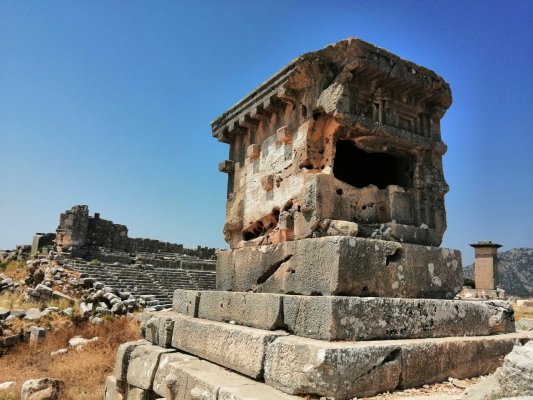
The ancient city consists of two main sections: the Lycian acropolis and the Roman acropolis, overlooking the Eşen (Xanthos) River. The Roman-era theatre in the heart of the city is very well preserved, and right next to it stand some of Lycia's most iconic monumental tombs. The most famous of these is the monumental tomb known as the "Harpy Tomb" due to its reliefs. This monument is proof of the richness of Lycian art and mythology; however, knowing that the original reliefs are now exhibited in the British Museum in London might add a bittersweet taste to your visit.
Another structure that makes Xanthos archaeologically priceless is the "Xanthian Obelisk" (the Inscribed Pillar). This monument, bearing the longest known inscription in the Lycian language, is considered the "Rosetta Stone" of Lycia and has played a key role in our understanding of this lost language. As you wander among the city's agora (marketplace), churches, and scattered sarcophagi, you can feel the victories and tragedies experienced by this once-powerful capital. You should set aside at least 2-3 hours to fully explore Xanthos, so be sure to take water, a hat, and comfortable shoes with you. After completing your visit, it would be a shame not to stop by its spiritual centre, Letoon, just a few kilometers away, to complete the story. These two cities are an inseparable duo that constituted the administrative and spiritual world of Lycia.
Reviews
No reviews yet