A Natural Source of Healing: Traditional Molasses (Pekmez) Making
When the autumn sun shines on Seydikemer, the grapes in the vineyards sweeten to perfection, and the carob trees yield their most mature fruit. This is nature's final act of generosity before winter, and for the people of the highlands, it signals the sweetest way to carry this bounty into the colder months: making Pekmez (molasses). Pekmez is more than just a breakfast food; it is a source of energy in the cold of winter, a shield against illnesses, and the bottled form of hours of labor and patience over a wood fire.
Step 1: The Harvest (Grapes and Carob)
The quality of the pekmez is directly related to the ripeness and sugar content of the fruit used.
- For Grape Molasses: Typically, local grape varieties that are juicy and sweet, known as "pekmezlik üzüm" (grapes for molasses), are chosen. The grapes are harvested in early autumn when they are at their sweetest. The bunches must be picked without being crushed or damaged and should be processed immediately.
- Crushing and Pressing: In the traditional method, the harvested grapes are placed in a large basin or big sacks called "şıra teknesi". They are then crushed by people wearing clean boots to extract the juice. This process prevents the seeds from being crushed and adding bitterness to the must. The resulting juice is strained to separate it from the pulp.
- Adding Soil and Resting: A special, marly clay known as "pekmez toprağı" (molasses soil) is added to the cloudy must to reduce its acidity and help clarify it. The mixture of must and soil is left to rest overnight in large containers. During this time, the weight of the soil causes the sediment in the must to settle at the bottom.
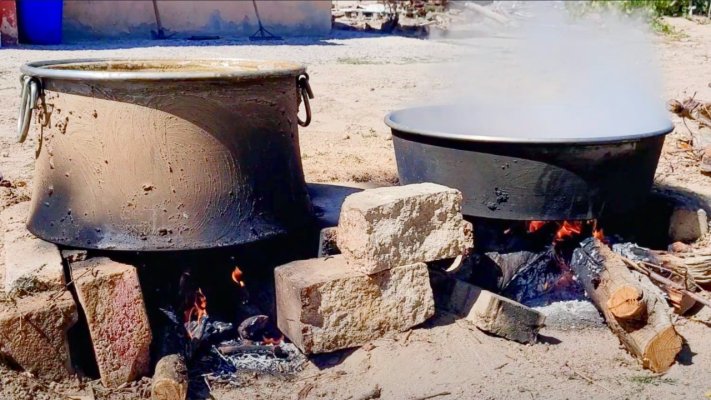
- The Transformation: The pekmez is boiled for hours, sometimes for 8-10 hours, while being stirred constantly. During this process, the water evaporates, the sugar content becomes concentrated, the color darkens, and it develops its characteristic pekmez consistency and taste. As it thickens, stirring becomes even more critical to prevent it from burning at the bottom.
For Carob Molasses: Ripe and dry carobs (harnup*) are gathered from the trees. These are usually broken into pieces and soaked in water to soften before being processed into molasses.
Step 2: Extracting the Essence (Obtaining the Must)
This stage involves extracting the sweet juice of the fruit, known as şıra (must).
Step 3: The Hours-Long Boil
This is the most laborious and skill-intensive part of making pekmez.
Clarification: The rested must is carefully decanted from the top, leaving the sediment at the bottom, and transferred into large, shallow cauldrons (kazan*).
Fire and Patience: A wood fire that will burn steadily and evenly is lit under the cauldron. As the must begins to boil, the foam (kef*) that forms on the surface is continuously skimmed off with a ladle. This process ensures the pekmez will be clear and delicious.
Step 4: The Consistency Test
To determine if the pekmez is ready after hours of boiling, a traditional test is performed. A drop of the boiling pekmez is placed on a cool, dry porcelain plate. If the drop holds its shape without running or spreading, the pekmez is ready.
Step 5: Cooling and Storing
Once it has reached the right consistency, the pekmez is removed from the fire and poured into wide, shallow trays to cool. It is often left under the sun for 1-2 days to further darken its color and perfect its consistency. Once completely cool, the pekmez is transferred into glass jars or earthenware pots to be stored in a cool, dark pantry throughout the winter.
Conclusion: A spoonful of pekmez is not just a sweet treat. It is concentrated life, containing the entire labor of a grape harvest, the energy of the summer sun, the warmth of the wood fire, and a family's hustle to prepare for winter. When mixed with tahini, it becomes a breakfast feast; when eaten alone, it is a natural source of healing.
Reviews
No reviews yet