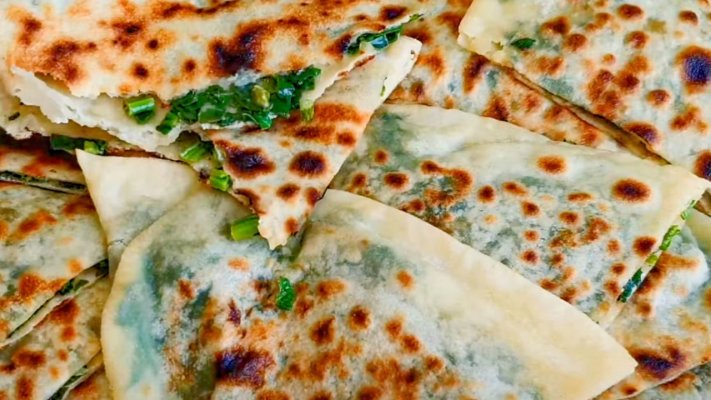
Traditional Seydikemer Gözleme with Herbs and Cheese
If you find yourself in front of a Yörük tent or a highland house, if the air smells of a wood fire and you hear sizzling sounds from a convex griddle, you are likely about to witness a feast of flavor: Gözleme is being made. But this is not just any gözleme. This is the famous gözleme specific to Seydikemer, which carries mastery in the thinness of its dough, knowledge of nature in its herbs, and the spirit of the highlands in its cheese. Here is the story of how that treasure is prepared:
Step 1: The Soul of the Gözleme: The Dough
First comes the dough. The ingredients couldn't be simpler: usually whole wheat flour, salt, and lukewarm water. However, the secret lies not in the ingredients, but in the hands that knead the dough.
- The dough is patiently kneaded until it is smooth, elastic, and has a non-sticky, soft consistency (often compared to an earlobe).
- The kneaded dough is covered with a clean cloth and left to rest for at least half an hour. This resting period allows the dough to be rolled out easily without tearing.
- The Mixture: The sautéed herbs and crumbled cheese are mixed, sometimes with a pinch of red pepper flakes, and the filling is ready.
- In skilled hands, the dough thins and expands with every stroke of the oklava, becoming a sheet of yufka so transparent you can almost see the pattern underneath. The greatest secret of this craft is to roll the yufka this thin without tearing it.
- The prepared herby cheese filling is generously spread over one half of the giant yufka.
- The empty half of the yufka is folded over the filling, and the edges are gently pressed down.
- The folded gözleme is lifted with the help of the oklava and laid onto the hot sac. The "sizzzle" sound from the sac is the sign that cooking has begun.
The rested dough is divided into small, palm-sized balls (beze*) and arranged on a floured tray.
Step 2: The Treasure of the Highlands: The Filling
This is the step that sets Seydikemer gözleme apart from others. The filling is prepared with whatever the highland nature offers at that moment.
Wild Herbs: In the spring and summer months, women gather medicinal and tasty herbs from the mountain slopes. These can include dozens of varieties like mallow (ebegümeci), nettle (ısırgan), poppy greens (gelincik otu*), and various other wild greens. These herbs are meticulously sorted, washed, finely chopped, and usually lightly sautéed with an onion in a little olive oil. Some herbs, like nettle, are only used after being boiled.
Highland Cheese: An essential component of the filling is low-salt or desalted highland cheese (yayla peyniri*). Sometimes, even the Deri Peyniri we described in our previous article is crumbled into it. The unique aroma of the cheese perfectly complements the earthy taste of the herbs.
Step 3: The Art of Rolling: The Yufka
This is the moment where skill and experience speak. The baker sits at a low wooden table or a cloth spread on the floor.
On a floured surface, a dough ball (beze*) is taken and begins to be rolled out with a long, thin rolling pin called an oklava.
Step 4: The Dance on the Fire: Cooking
The sac, a convex iron plate heated by a fire of oak wood underneath, is thoroughly hot.
Within seconds, bubbles form on the dough, and the underside turns golden brown in spots. It is flipped with a flat spatula (bişirgeç*) and the other side is cooked in the same way. This entire process takes less than a minute.
Step 5: The Final Touch: Greasing and Serving
As soon as the hot gözleme is taken off the sac, it is immediately brushed with fresh butter, also made in the highlands. The butter instantly melts from the heat of the gözleme, spreading all over and releasing its unique aroma. It is usually folded into a square or rolled up and served steaming hot with a glass of frothy ayran or a freshly brewed cup of tea.
Conclusion: When you take a bite of Seydikemer gözleme, you are not just eating flour, herbs, and cheese. You are also tasting the mastery of the hand that rolled the dough, the nature knowledge of the woman who gathered the herbs, the labor of the Yörüks who made the cheese and butter, and the warmth of the wood fire. In short, you are fitting an entire highland culture into a single bite.
Reviews
No reviews yet